Blog · Lot yield
Huntington Beach, California · Published
By Brian Woods, Land Development Specialists
How Many Homes Can You Build on 40 Acres?
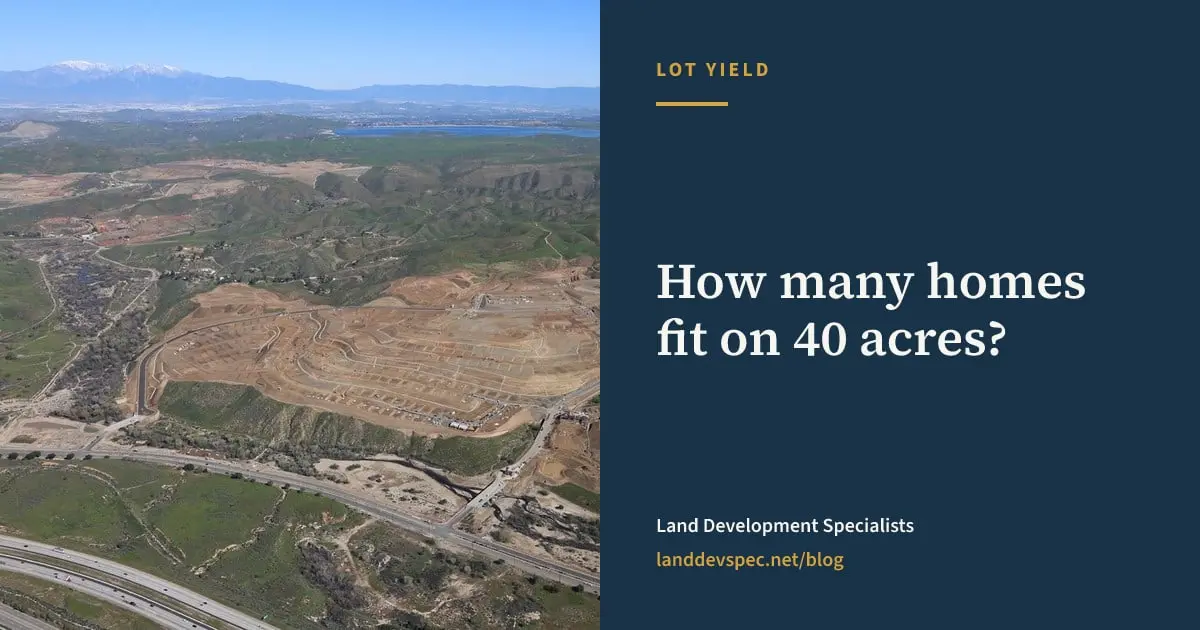
Huntington Beach, California · Landowners often ask how many homes a parcel will hold before they decide to buy, sell, or plan. On a 40-acre site the honest answer is a range, and the range comes from testing a layout against the rules and the ground, not from dividing the acreage by the minimum lot size.
Why simple math gives the wrong number
The zoning and the general plan set a starting point for density. After that, streets, slopes, drainage, easements, utilities, parks, and open space all take land out of the count. Watercourses, riparian habitat, and other protected areas can remove more.
Dividing total acreage by the minimum lot size skips all of that, so it usually promises more lots than a real map will show. A low asking price on a parcel that looks big is not a good deal if the improvements eat the value of the lots.
What decides the count
For homes, the review covers these before a layout is drawn:
- Density limits and lot-size rules in the zoning and general plan
- Parcel shape, setbacks, and the street standards that apply
- Road access and emergency access
- Slope, grading, and the kind of ground: rock, clay, or sand
- Water, sewer, and power, and whether there is capacity to connect
- Drainage, and any habitat or watercourse that limits the usable land
How the number gets tested
A good land planner can improve how a site is used through careful street and lot layouts. The concept plan should show real lots and the infrastructure that serves them, so the count reflects what can actually be built.
The first result is a realistic range with its assumptions written down. The final approved count depends on detailed design and on what the agency approves. Brian runs that count as part of a land development feasibility study, and he says which parts are known and which are still a guess.
When the answer is to walk away
Some parcels do not work at any count. The main reasons Brian sees are a lack of utility capacity, too many environmental constraints, and large off-site infrastructure costs. Finding those before closing is the reason the study comes first. For larger acreage planned in phases, see master-planned communities.
About Land Development Specialists
Land Development Specialists LLC is led by Brian Woods, who has more than 40 years in residential land development. He helps landowners, builders, and investors in Orange County, Los Angeles County, Riverside County, and southern San Bernardino County, including the Inland Empire, with feasibility, entitlements, infrastructure, and project management. The work fits subdivisions of 50 to 200 lots and apartment sites of about 50 to 200 units.
Contact Brian Woods at (760) 271-1081 or brian@landdevspec.net.